Sécurité des meubles de bureau intelligents : capteurs anti-collision et gyroscope
Découvrez comment les systèmes anti-collision avancés et les capteurs gyroscopiques révolutionnent la sécurité au travail. Ce guide explore la logique technique derrière les contrôleurs IPC1 et IPC2 d'ActuLift, détaillant comment la détection d'obstacles en temps réel et le contrôle de la stabilité protègent les utilisateurs et l'équipement dans des environnements ergonomiques modernes.
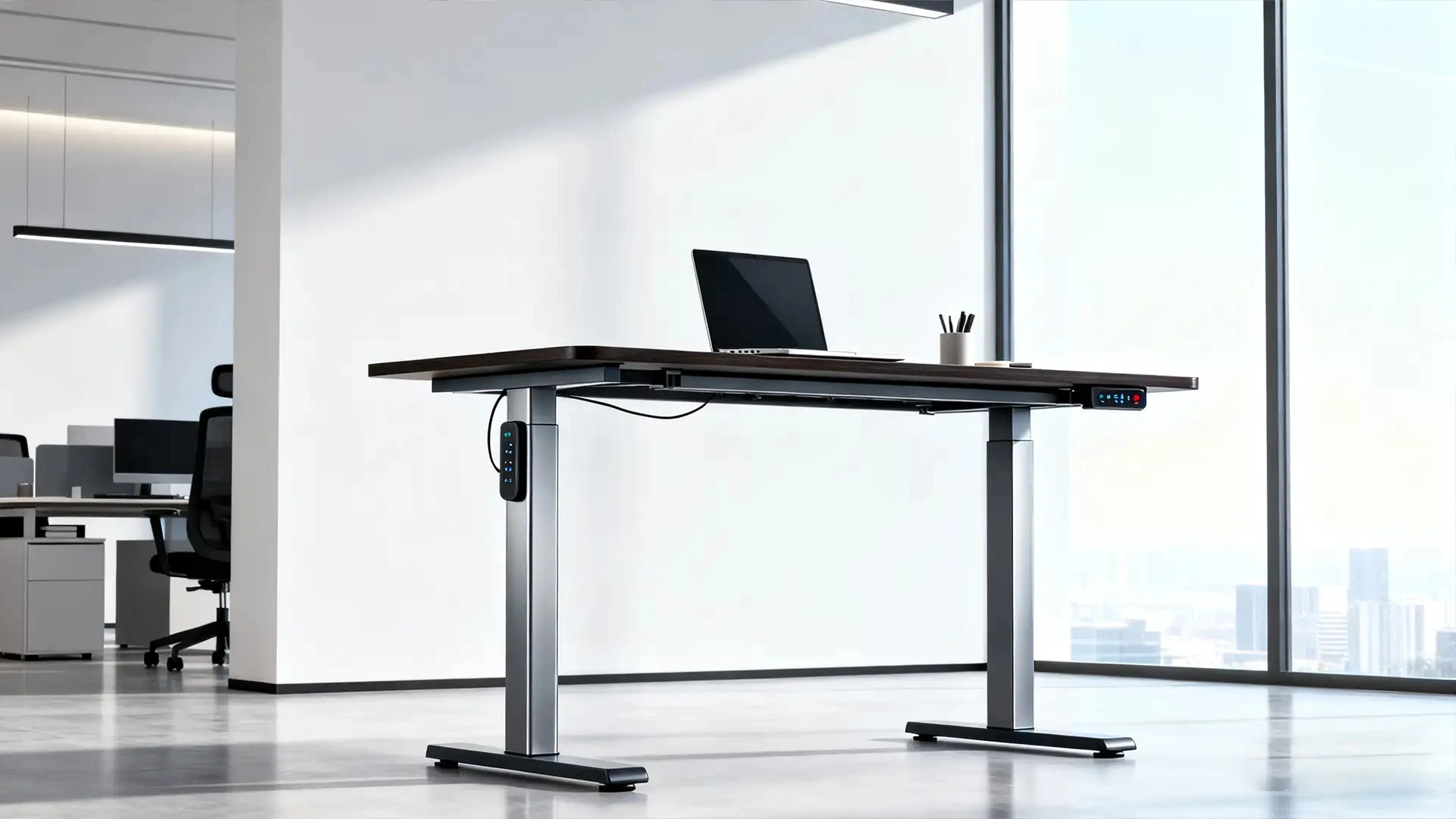
Le lieu de travail moderne a subi une transformation spectaculaire. Les bureaux debout, autrefois considérés comme un luxe, sont devenus un élément essentiel dans les bureaux du monde entier alors que les organisations adoptent l'ergonomie et le bien-être des employés. Pourtant, avec cette évolution vient une responsabilité critique : garantir que la technologie conçue pour améliorer notre vie professionnelle ne compromet pas notre sécurité. L'intégration des systèmes anti-collision de bureaux debout et de la technologie de bureau debout gyroscopique représente une avancée cruciale en matière de sécurité au travail, protégeant les utilisateurs des dangers potentiels tout en offrant l'expérience fluide que les professionnels modernes attendent.
Table des matières
1. Introduction : L'évolution des meubles de bureau intelligents et pourquoi la sécurité est importante
Motorized height-adjustable desks combine moving columns, actuators, controllers, wiring and a user interface. That architecture creates system-level safety questions around clearances, load, pinch/crush zones, travel limits, obstruction behavior and fault response that the finished-desk manufacturer must address.
Motorized desks can generate forces capable of damaging objects or creating pinch/crush hazards depending on the mechanism and load. Do not use a generic force figure; evaluate the selected columns, frame geometry, speed, controls and foreseeable obstruction scenarios in the finished desk risk assessment.
ActuLift offers configurable controller platforms that can be evaluated as part of a standing-desk control architecture. Any obstruction detection, anti-collision, rebound, gyroscope or other safety function must be confirmed for the selected controller/handset/actuator configuration and validated on the finished desk; no controller should be treated as preventing accidents by itself.
Pour l'ergonomie et les solutions de bureau intelligentes, define technical safety requirements, applicable furniture/electrical standards, user instructions, mechanical protections and validation evidence. Avoid converting a component feature into claims about injury prevention, medical cost or productivity outcomes.
2. Comprendre la technologie anti-collision : comment cela fonctionne et pourquoi c'est essentiel
Standing-desk anti-collision is a general term for control functions intended to detect abnormal resistance, motion or other obstruction indicators and apply a defined response. Detection method, sensitivity, stopping distance, reversal behavior and residual force vary by implementation and must be validated on the complete desk.
Some systems use motor current or other electrical/motion signals as one input to obstruction detection; others may use additional sensors. Do not assume every controller uses the same detection method or reliably distinguishes an obstruction from load, friction, binding or normal transients without configuration-specific validation.
A controller may be configured to stop motion when its obstruction criterion is met. If a pause/stop behavior is required, define the trigger, stopping behavior, reset/restart logic and acceptance test rather than assuming a standard “pause mode.”
Some systems may use a stop-and-reverse response after an obstruction criterion is reached. If rebound is required, specify reversal distance/time, speed, load, trigger threshold and fault cases, then validate that behavior on the finished desk. Reversal does not guarantee that contact, damage or injury cannot occur.
In offices, moving desks can interact with chairs, storage, partitions, cables and people. Anti-collision can be one layer in the risk-control strategy, alongside mechanical clearance, travel limits, user instructions and installation layout; its effectiveness must be measured under representative conditions.
3. IPC1/IPC2: Confirm Safety Functions by Configuration
IPC1 and IPC2 are configurable controller platforms. Current product evidence does not establish a universal anti-collision, gyroscope, pause/rebound or other safety package for either model; confirm the selected configuration, connected actuators/feedback and finished-desk safety logic.
Le IPC1 controller is currently documented as a configurable OEM controller platform. Confirm channel arrangement, actuator current, control interface, feedback, travel limits, obstruction/safety functions and wiring for the ordered build; do not assume it is a single-column safety controller.
If an IPC1 configuration includes obstruction detection, document the sensing method, thresholds and response states. Pause/stop behavior should be treated as a configuration-specific function and tested with the actual actuator/frame/load.
Do not assume IPC1 provides rebound, a millisecond response or a predefined reversal distance. If stop/reverse behavior is required, confirm it in current controller documentation and validate stopping/reversal performance on the finished desk.
Travel-limit and end-of-stroke behavior depend on the actuator, controller, feedback/limit method and commissioning. Confirm the selected system’s limit logic and fault behavior rather than assuming IPC1 prevents overload at the mechanical endpoints.
Le IPC2 controller is currently documented as a dual-actuator architecture. Final behavior depends on compatible actuators, feedback signals, wiring, current limits, commissioning and the finished desk; anti-collision or other safety functions must be confirmed separately.
For IPC2, define the permitted synchronization error and validate it under representative loads and travel. A dual-actuator controller does not guarantee perfect coordination, and desk stability also depends on frame stiffness, load distribution, mounting and mechanical guidance.
Do not assume IPC2 can independently stop/reverse one side during an obstruction or that such a response is safe for the desk structure. If differential fault/obstruction behavior exists, obtain the controller logic and validate the resulting skew, forces and stop response on the complete mechanism.
Do not infer automatic load balancing or proactive power redistribution from the IPC2 model name. Confirm how the selected controller handles channel mismatch, current limits, feedback errors and faults, and test those cases on the finished desk.
Scénarios de sécurité dans le monde réel
Use obstruction scenarios as validation cases rather than proof of controller performance. For example, a cable, chair arm or storage unit can enter the desk’s travel path; define the test object, location, desk load, speed and acceptable stopping/reversal behavior.
Do not assume IPC1 or IPC2 automatically detects such an obstruction or responds within a particular time. If the selected configuration includes obstruction detection, validate whether it stops, reverses or faults under representative conditions and measure the residual force/distance against the project acceptance criteria.
Where a moving desk can contact a person or nearby object, address that hazard through layout, clearances, user instructions, mechanical design and validated control behavior. Anti-collision should not be described as guaranteeing injury prevention.
Boîtiers de commande et contrôleurs are one part of the safety architecture. The required functions and validation depend on the complete desk design, applicable requirements and selected controller/actuator configuration.
4. Gyroscope Sensors: Motion Input, Not a Safety Guarantee
Une capteur gyroscopique can provide angular-motion information to a desk controller when such a sensor is actually included in the system. That signal may be used as one input to motion or stability logic, but a gyroscope alone does not prevent tipping or establish finished-desk safety.
Gyroscopes measure angular velocity; orientation or tilt estimates generally depend on sensor fusion, integration and controller implementation. If tilt/motion monitoring is required, define the relevant threshold, sampling/filtering behavior, mounting location and response logic, then validate the complete desk under representative loads and disturbances.
A controller may use inertial-sensor data to trigger an alert, stop or other configured response, but those functions are implementation-specific. Do not assume automatic lowering or any other protective action unless it is documented for the selected controller and validated on the finished desk.
Inertial data may complement current, position or other signals in an obstruction/stability algorithm. Whether that improves classification, nuisance-trigger performance or response accuracy must be demonstrated for the actual control implementation rather than assumed from the presence of a gyroscope.
For commercial desks, determine whether inertial monitoring is necessary from the finished-product hazard analysis and user environment. If used, verify the sensor/controller behavior and acceptance criteria; do not claim protection of people or equipment without system-level evidence.
5. Emerging Safety Functions: Treat Them as Requirements to Validate
Additional sensing, diagnostics and connectivity may be considered in future or custom desk-control architectures. Treat each proposed function as a project requirement with defined inputs, outputs, failure modes, cybersecurity/privacy considerations where relevant, and validation evidence.
If predictive diagnostics or machine-learning logic is proposed, define the data source, model behavior, false-positive/false-negative limits, update/change-control process and what action follows an alert. Do not assume predictive maintenance or hazard prevention without validated field evidence.
For connected l'ergonomie et les solutions de bureau intelligentes, specify the required interfaces, permissions, latency, fault behavior, privacy/security controls and safe behavior when connectivity is unavailable. Integration with occupancy or building systems is not a default controller capability.
Radar, ultrasonic, optical or proximity sensing can be evaluated when non-contact detection is required. Define detection zones, target types, environmental limitations, response time and fallback behavior, then validate the selected sensor/controller implementation.
ActuLift can review project-specific control and sensing requirements against available controller platforms. Any custom or emerging function should be confirmed through the applicable specification, prototype and validation process rather than assumed from this article.
6. Conclusion : Prioriser la sécurité dans la conception de bureaux intelligents
Anti-collision logic, inertial sensing and other controller functions can be evaluated as layers in a standing-desk safety strategy. Their presence does not transform the desk into an inherently safe or protective system; effectiveness depends on the complete desk design and validation.
IPC1 and IPC2 should be treated according to their current controller contracts: IPC1 is a configurable OEM controller platform and IPC2 is a dual-actuator controller architecture. Any anti-collision, rebound, gyroscope or other safety function requires configuration-specific documentation and finished-desk testing.
Pour (y compris des modèles en L et exécutifs) et des accessoires de bureau essentiels and control systems, define hazards, technical requirements, applicable standards, component compatibility and acceptance tests before production. New sensing or control features should be added only when their behavior and failure modes are understood and validated at finished-product level.
Sources & Evidence Boundary
IPC1 current product page — configurable OEM controller; confirm channels, current, interfaces, feedback, wiring and safety functions by configuration.
IPC2 current product page — dual-actuator controller architecture; final behavior depends on compatible actuators, feedback, wiring and commissioning.
BIFMA standards overview — background only; identify and verify the exact standard/edition and conformity evidence applicable to the finished desk.
Obtenez des Aperçus d'Experts sur le Contrôle de Mouvement Industriel
Sélectionner le bon vérin linéaire électrique ou colonne de levage est crucial pour la performance de votre projet. En tant que fabricant professionnel de Contrôle de Mouvement & Automatisation, nos ingénieurs vous aident à personnaliser la capacité de charge, la longueur de course et les classes IP en fonction de votre application spécifique. Partagez vos exigences techniques pour une solution sur mesure.
ActuLift prend en charge la personnalisation de bout en bout, de la conception structurelle et des paramètres de course aux finitions de marque et de boîtier, vous aidant à construire une identité de marque puissante.
Réponse rapide et prototypage
Nous comprenons l'importance de la rapidité dans l'approvisionnement B2B, en utilisant des flux de production optimisés pour garantir des réponses efficaces du développement d'échantillons à la livraison en gros.
Quality Documentation & Traceability
Quality and traceability requirements vary by project. Ask ActuLift for the applicable inspection records, product specifications, drawings and available compliance documentation for the selected model and order.