Linear Actuators for Solar Trackers: Wind Load & Holding Validation
Erfahren Sie, wie die hohe statische Haltekraft in linearen Aktuatoren, insbesondere der IP1200-Serie, Solartacksysteme vor strukturellen Schäden durch hohe Windlasten schützt. Entdecken Sie die technischen Anforderungen zur Gewährleistung der Zuverlässigkeit und zur Maximierung des ROI in solarbetriebenen Kraftwerken.
Evaluate linear actuators for solar trackers by moving load, static holding, back-driving, wind/stow conditions, feedback, environment and configuration-specific evidence.
Inhalt
Warum Solarnachführungen in der modernen erneuerbaren Energie wichtig sind
Solar energy has become one of the most viable alternatives to fossil fuels, and solar power plants are being deployed on a large scale worldwide. Solar tracking can change energy capture relative to a fixed-tilt design, but the actual yield difference depends on site latitude, tracker geometry, controls, stow strategy, irradiance, shading, availability and the project baseline. Do not assign a universal percentage gain to the actuator itself.
Im Herzen jedes zuverlässigen Solarnachführsystems befindet sich der lineare Aktuator – das elektromechanische Gerät, das Drehbewegung in lineare Bewegung umwandelt, um den Winkel der Solarmodule im Laufe des Tages zu ändern. Die Auswahl des richtigen linearen Aktuators für Anwendungen mit Solarnachführungen ist entscheidend, insbesondere wenn diese Systeme anspruchsvollen äußeren Bedingungen standhalten müssen.
Die kritische Herausforderung: Windlasten und strukturelle Anforderungen
Solarnachführsysteme arbeiten unter einigen der anspruchsvollsten Umweltbedingungen. Im Gegensatz zu festen Solarinstallationen haben Nachführsysteme bewegliche Teile, die eine präzise Positionierung aufrechterhalten müssen, während sie ständig den Elemente ausgesetzt sind. Unter diesen Herausforderungen stellt die Windlast die bedeutendste strukturelle Bedrohung für die Leistung und Langlebigkeit von Solarnachführungen dar.
When strong winds strike a solar array, they create substantial forces that push against the panel surface. Wind load on a tracker must be calculated from the site wind conditions, array geometry, structural coefficients, stow position and load path; a generic force figure should not be used for actuator selection. Without adequate holding capacity, the tracking system may experience:
Unbeabsichtigte Panelbewegung die die Energieproduktion reduziert
Mechanischer Verschleiß durch ständige Schwingungen unter dem Winddruck
Vorzeitiger Komponentenversagen was zu kostspieligen Ausfallzeiten führt
Sicherheitsrisiken wegen struktureller Instabilität
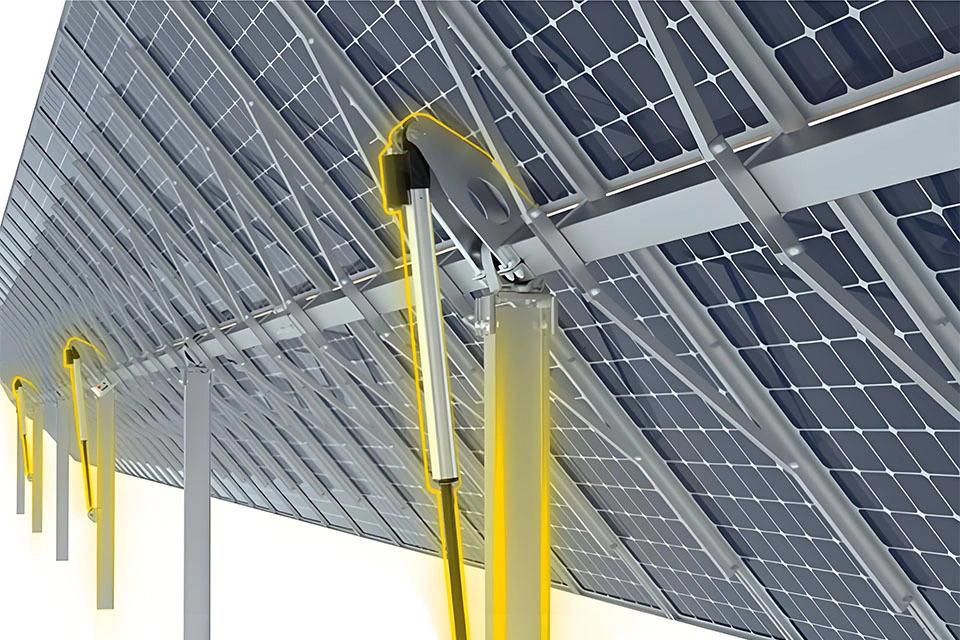
Static holding or back-driving behavior is one important actuator requirement, but it must be reviewed together with moving load, linkage geometry, structural deflection, stow strategy, brake/holding architecture and the allowable load cases of the complete tracker.
Die Lösung: Hochstatische Haltekraft lineare Aktuatoren
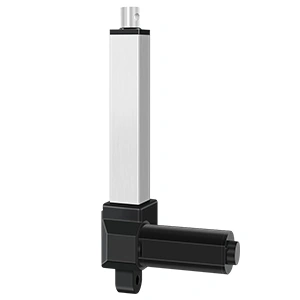
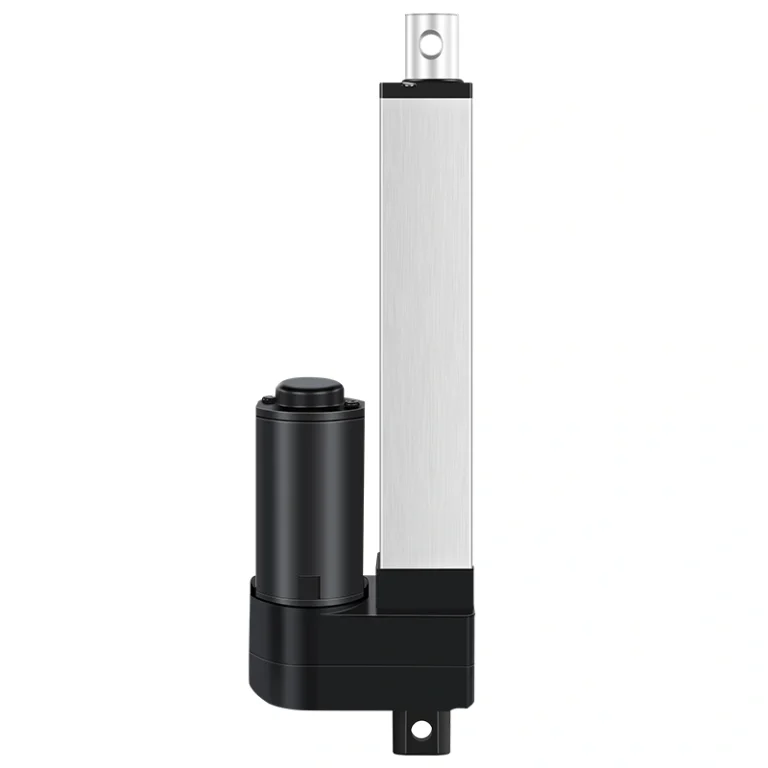
For solar-tracker projects, IP1200 can be evaluated as a configurable higher-load OEM actuator candidate. Final suitability depends on the selected build, tracker geometry, wind/stow load cases, holding behavior, controls, environment and supporting test documentation.
Warum hochstatische Haltekraft wichtig ist
For an IP1200 solar-tracker project, define the required moving load, static holding/back-driving condition, stroke, speed, duty cycle, mounting geometry, controller and wind/stow load cases first. Then confirm the selected actuator configuration against those requirements.
When wind acts on the array, the actuator and linkage become part of the structural load path. Validate the selected IP1200 configuration for the actual mechanism rather than assuming a generic wind-speed capability:
Wind load: convert the project wind case into actuator force and structural reactions for the actual tracker geometry
Positioning: measure panel-angle error on the complete tracker under representative load, temperature and wind conditions
Lifecycle: define cycle, load, stow events, environment and acceptance criteria before evaluating durability
Maintenance: model inspection, access, spares, replacement time and field conditions instead of assuming lower cost from the actuator family alone
Technische Vorteile für Außenanwendungen mit Solarenergie
Über die statische Haltekraft hinaus bietet der IP1200 schwerlast-lineare Aktuator zusätzliche Spezifikationen, die für Solarverfolgungsanwendungen entscheidend sind:
Environmental Protection: Define the site’s dust, rain, condensation, temperature, UV, corrosion, cable and connector exposure. Request current configuration-specific ingress-protection evidence; do not assume IP66 or a higher rating applies to every IP1200 or IP800 build.
Durability: Für IP800, IP1200 or any other candidate, define the required lifecycle, load, stroke, speed, duty cycle and environment, then request applicable test evidence. Do not infer a fixed lifecycle figure or lower maintenance cost without a configuration-specific validation record.
Positioning and Feedback: Tracker accuracy is a system result. Confirm actuator feedback, controller resolution, linkage geometry, backlash, calibration and structural deflection, then measure the actual panel angle under representative conditions. Do not treat an actuator-family description as a universal 0.1° tracker-accuracy specification.
Anwendungsüberlegungen für die Integration von Solartrackern
Bei der Auswahl von linearen Aktuatoren für Solarverfolgungssysteme sollten Ingenieurteams mehrere Schlüsselfaktoren neben den grundlegenden Kraftspezifikationen bewerten:
Systemarchitektur
Einachsige vs. dualachsige Verfolge: Dualachssysteme benötigen mehr Aktuatoren, bieten jedoch größere Energieausbeute
Arraygröße: Größere Anlagen profitieren von Aktuatoren mit höheren Haltekraftbewertungen
Montageorientierung: Landschafts- und Hochformatkonfigurationen erzeugen unterschiedliche Lastprofile
Umweltfaktoren
Windzonenklassifikation: Bestimmen Sie die maximal erwarteten Windgeschwindigkeiten für den Installationsort
Temperaturbereich: Stellen Sie die Leistung des Aktuators über saisonale Temperaturextreme hinweg sicher
UV-Belastung: Wählen Sie Aktuatoren mit UV-beständigen Materialien für den langfristigen Einsatz im Freien
Integrationsanforderungen
Kompatibilität der Stromversorgung: Überprüfen Sie, ob die Spannungsanforderungen mit der verfügbaren Infrastruktur übereinstimmen
Steueroberfläche: Sicherstellen, dass die Integration mit SCADA-Systemen oder intelligenten Verfolgungssteuerungen erfolgt
Montagevorschriften: Bestätigen Sie die mechanische Kompatibilität mit den Designs des Verfolgungsrahmens
Für Hersteller, die Solarverfolgungslösungen entwickeln, kann die Zusammenarbeit mit einem erfahrenen Aktuatorenlieferanten früh im Designprozess die Integration vereinfachen und die Systemleistung optimieren.
Was ist der Unterschied zwischen dynamischer Last und statischer Haltekraft in Solarnachführungen?
Dynamic load describes the force required while the mechanism is moving. Static holding or back-driving behavior describes the stationary condition. Both must be confirmed for the selected actuator and actual tracker geometry, orientation, duty cycle and safety factor.
How should ingress protection be selected for a solar-tracker actuator?
Start from the site exposure, mounting orientation, cable and connector arrangement, cleaning method and enclosure interfaces. Then request configuration-specific IP evidence. There is no universal rule that every solar-tracker actuator must be IP66.
How can an actuator affect solar-tracker project economics?
An actuator can influence tracking availability, maintenance, stow behavior and positioning, but energy yield and ROI are system-level outcomes. Compare a defined baseline using the same site, controls, weather period and availability assumptions rather than assigning a fixed percentage gain to the actuator.
Fazit: Investieren in Zuverlässigkeit
Da die Solarenergie weltweit weiter expandiert, wird die Nachfrage nach zuverlässigen, leistungsstarken Verfolgungssystemen nur steigen. Die Wahl des linearen Aktuators für Solarverfolgeranwendungen hat direkte Auswirkungen auf die Systemzuverlässigkeit, die Energieerträge und die langfristige Rentabilität.
For wind-loaded solar-tracker applications, compare candidate Hochleistungsaktuatoren using the project’s moving load, static holding/back-driving requirement, stroke, speed, duty cycle, controls, environmental exposure, stow strategy and configuration-specific evidence. IP1200 is one candidate to validate, not a universal solution.
Erhalten Sie Experteneinblicke in die industrielle Bewegungssteuerung
Die Auswahl des richtigen elektrischen linearen Aktuators oder Hebensäule ist entscheidend für die Leistung Ihres Projekts. Als professioneller Hersteller von Bewegungssteuerungen & Automatisierung, helfen unsere Ingenieure Ihnen, die Lastkapazität, den Hub, und die IP-Bewertungen basierend auf Ihrer spezifischen Anwendung anzupassen. Teilen Sie uns Ihre technischen Anforderungen für eine maßgeschneiderte Lösung mit.
ActuLift unterstützt End-to-End-Anpassungen, vom strukturellen Design und Hubparametern bis hin zu Branding und Gehäusefinishes, damit Sie eine starke Markenidentität aufbauen können.
Schnelle Reaktion & Prototyping
Wir verstehen die Bedeutung von Geschwindigkeit in der B2B-Beschaffung und nutzen optimierte Produktionsabläufe, um effiziente Antworten von der Mustentwicklung bis zur Serienlieferung sicherzustellen.
Quality Documentation & Traceability
Quality and traceability requirements vary by project. Ask ActuLift for the applicable inspection records, product specifications, drawings and available compliance documentation for the selected model and order.