Representative OEM Scenario: 3-Stage Lifting Columns for Ergonomic Desks
A representative OEM engineering scenario for selecting 3-stage lifting columns by travel, load, noise, synchronization, controls and configuration-specific evidence.
Procurement and engineering teams evaluating premium sit-stand desks often need a lifting system that balances travel, retracted height, load, motion quality, synchronization, controls, appearance, serviceability and documentation. Those requirements should be defined as a project brief rather than inferred from a generic product-family label.
Representative scenario: This article is an engineering walkthrough based on common OEM sourcing questions. It is not a customer-specific case study, does not identify a real furniture brand, and does not claim that the example targets or outcomes were achieved on every IPTT-DD configuration.
The purpose is to show how a sourcing team can evaluate 3-stage lifting-column architecture and then validate an IPTT-DD configuration through drawings, samples, system tests and order-specific documentation.
Tabela de Conteúdos
1. Define the Project Requirements
Start with the finished desk rather than a claimed column specification. Define target minimum and maximum desk height, required travel, desktop/frame mass, expected payload, lifting speed, acceptable noise method and limit, duty cycle, controller functions, synchronization tolerance, collision response, cable routing, mounting geometry, finish and target markets. For the mechanical/control interaction behind that tolerance, see lifting column stability and synchronization.
For acoustic, durability, lifecycle or compliance targets, write down the acceptance method as well as the number. A target such as “below 45 dB” is not meaningful without load, speed, measurement distance, room background noise and test procedure. Likewise, a lifecycle target requires a defined load profile, travel pattern, duty cycle and pass/fail criteria.
2. Why a 3-Stage Architecture May Fit
A 3-stage column can provide a different relationship between retracted height and extended height than a 2-stage design, which can be useful when a desk needs both a compact low position and a larger total travel. The actual dimensions, overlap, lateral stiffness and usable travel depend on the selected column geometry and frame.
Do not assume that 3-stage is automatically superior or that a fixed dimension range satisfies accessibility or ergonomic standards. Compare the required desk-height envelope, column installation dimensions, frame stiffness and load case against the selected model. See ActuLift’s 2-stage vs 3-stage lifting-column guide for the architectural trade-offs.
3. Evaluating an IPTT-DD Configuration
O IPTT-DD is currently presented as a configurable OEM lifting-column platform. Its product page requires load, travel, speed, control, synchronization, environmental protection and documentation to be confirmed for the selected build rather than treated as universal specifications.
Load: confirm the required axial/dynamic load, the rated load for the selected column build, safety factor and test conditions.
Travel and geometry: confirm travel, retracted/extended dimensions, mounting points and frame clearances.
Speed and duty cycle: confirm movement speed under the expected load and the permitted run/rest profile.
Synchronization and feedback: confirm the applicable feedback method, controller, wiring and synchronization acceptance criteria.
Environment and finish: confirm material, finish, cable/connector arrangement and configuration-specific protection requirements.
Documentation: request the current drawing, specification, applicable test records and any configuration-specific compliance declarations needed by the project.
Controller features such as anti-collision, tilt/gyroscope logic, current sensing or reversal behavior must also be validated for the selected control architecture and complete desk. Do not infer a particular sensor count, pulse rate, collision performance or injury-prevention result from a generic controller description.
4. Representative OEM Validation Workflow
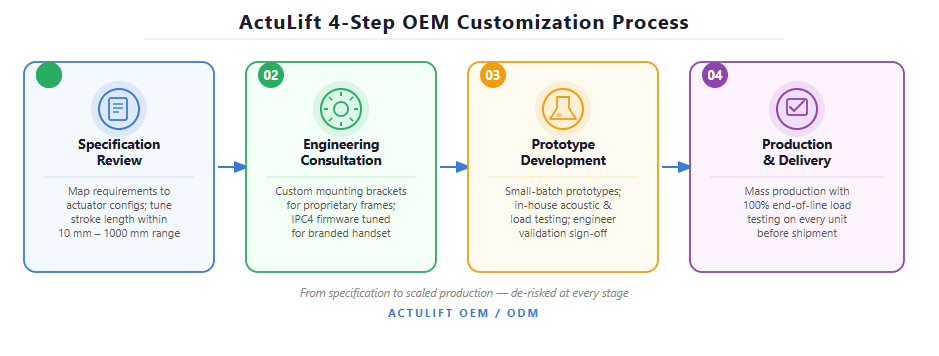
A practical OEM workflow starts with a specification review that maps the desk-height envelope, load case, speed, noise target, duty cycle, synchronization, controls, finish, mounting and documentation requirements to candidate column configurations.
The next step is mechanical and electrical integration: review drawings, bracket interfaces, frame stiffness, controller/handset requirements, cable routing and the complete motion envelope. Any custom bracket, firmware, handset or finish requirement should be frozen in an approved configuration before production.
Prototype and sample validation should then reproduce the intended load, desk geometry and operating conditions. Acoustic, load, synchronization, collision response, lifecycle and environmental tests should be documented with the method and configuration. Production release should reference the approved drawing/specification and the quality records actually required for that order. ActuLift’s OEM/ODM process can be used as the project framework.
5. Validation Outcomes to Document
For a representative ergonomic-desk program, the useful outcome is not an unsupported claim that every system runs below a fixed dB level, never drifts, lasts a fixed number of years or enters a regulated market automatically. The useful outcome is a traceable set of configuration-specific validation records.
Measured acoustic result with load, speed, distance, background noise and test setup recorded.
Synchronization and levelness behavior across the required travel and representative uneven loads.
Load, stability and frame-integration results for the approved desk geometry.
Lifecycle or endurance result tied to a defined cycle, load, duty cycle and acceptance criterion.
Current product/order documentation, including applicable declarations or material-compliance records where required.
Production inspection or test records that are actually specified for the purchase order.
6. Conclusões para Equipes de Compras
For premium ergonomic furniture, treat the lifting system as an integrated mechanism rather than a collection of headline specifications. A quiet, stable and durable desk depends on the columns, frame, controller, feedback, mounting, load, motion profile and validation method working together.
Choose 2-stage or 3-stage architecture from the required height envelope, travel and frame geometry—not from a blanket “better” claim.
Define synchronization and acoustic acceptance criteria before sampling, then measure the complete desk under representative conditions.
Use configuration-specific drawings, test evidence and documentation as the release gate for procurement and production.
If an existing column platform does not meet the project’s load, travel, controls, mounting or validation requirements, review ActuLift’s custom OEM/ODM options and define the required configuration before requesting samples.
Perguntas Frequentes
What is the practical difference between 2-stage and 3-stage lifting columns?
A 3-stage design can provide a different ratio of retracted height to total extension than a 2-stage design. The actual travel, minimum and maximum height, overlap and stiffness depend on the selected column and frame, so compare approved drawings against the desk-height envelope.
Qual é a quantidade mínima de pedido para uma configuração IPTT-DD personalizada?
MOQ depends on the selected configuration, tooling, finish, controller, packaging and other customization requirements. Confirm the current commercial MOQ and pricing for the specific project rather than relying on a generic range.
Can an IPTT-DD project target operation below 45 dB?
A project can define an acoustic target, but it should not be treated as a universal IPTT-DD specification. Confirm the selected configuration and validate the complete desk under a defined load, speed, measurement distance, ambient noise level and test method.
How should dual-column synchronization be validated?
Confirm the selected feedback method, controller, wiring and synchronization logic, then test the complete frame across its required travel, load distribution and duty cycle. Long-term drift performance requires lifecycle validation under the project’s conditions.
Which compliance documents are included with IPTT-DD?
Documentation is configuration- and order-dependent. Request the current declarations, material-compliance records, test reports or other documents required by the project and confirm their scope before approval.
Obtenha Insights de Especialistas em Controle de Movimento Industrial
Selecionar o atuador linear elétrico ou coluna de elevação é crítico para o desempenho do seu projeto. Como um fabricante profissional de Controle de Movimento & Automação, nossos engenheiros ajudam você a personalizar a capacidade de carga, comprimento de curso e classificações IP com base em sua aplicação específica. Compartilhe seus requisitos técnicos para uma solução sob medida.
A ActuLift apoia a personalização de ponta a ponta, desde o design estrutural e parâmetros de curso até branding e acabamentos de carcaça, ajudando você a construir uma identidade de marca poderosa.
Resposta Rápida & Prototipagem
Entendemos a importância da rapidez na aquisição B2B, utilizando fluxos de produção otimizados para garantir respostas eficientes desde o desenvolvimento de amostras até a entrega em massa.
Quality Documentation & Traceability
Quality and traceability requirements vary by project. Ask ActuLift for the applicable inspection records, product specifications, drawings and available compliance documentation for the selected model and order.