For a small, battery-powered device, 12V can be the cleanest answer. If the equipment already has a 12V battery, short wires, one actuator, and moderate load, there may be no reason to complicate the design.
Industrial OEM equipment is different.
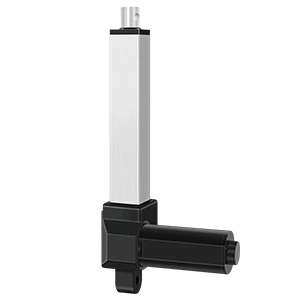
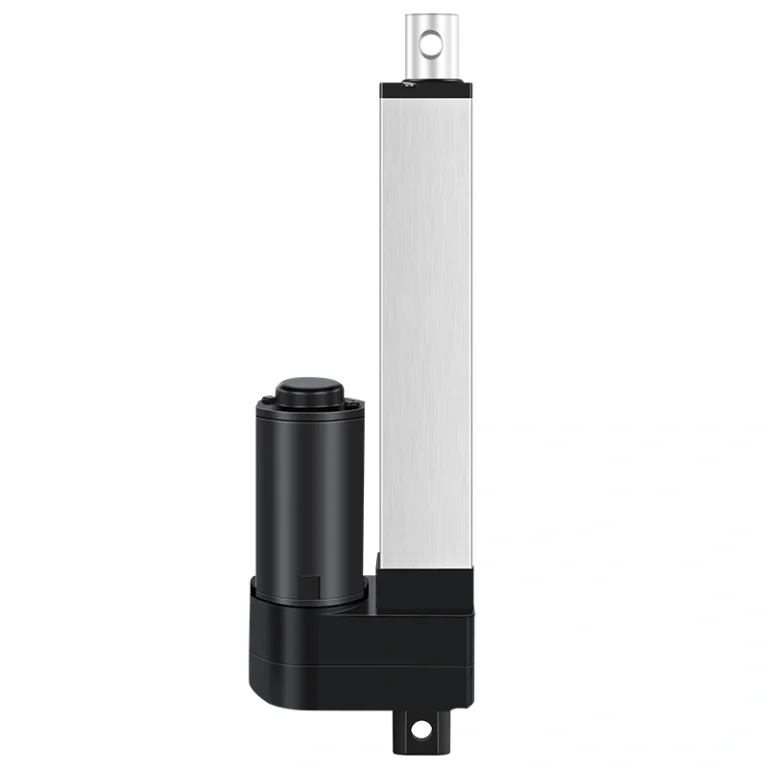
In factory machines, medical devices, agricultural equipment, access panels, lifting mechanisms, smart furniture, and automation modules, the actuator is rarely a standalone part. It has to work with a power supply, controller, wiring harness, brackets, feedback signals, duty cycle limits, enclosure design, and service expectations. In that kind of system, อุปกรณ์กระตุ้นเชิงเส้น 24V are often easier to integrate and more stable to scale.
The key word is often. A 24V actuator is not automatically stronger than a 12V actuator. Force depends on the motor, gearbox, screw design, load rating, speed configuration, and mechanical structure. But for many industrial OEM projects, 24V gives engineers a better electrical starting point.
สารบัญ
เหตุผลทางไฟฟ้า: 24V สามารถลดความต้องการกระแส
The practical advantage of 24V starts with a basic relationship:
Power = Voltage x Current
If two actuator systems need a similar amount of power, the higher-voltage system can usually operate with lower current. In a simplified calculation, a 120W actuator load draws about 10A at 12V, but about 5A at 24V.
That current reduction matters because cable and copper heating follow Joule’s law:
P_loss = I^2 x R
In this formula, P_loss is the heat loss in the conductor or component, I is current, and R is electrical resistance. If the current is cut in half while resistance stays the same, the I^2 term becomes one quarter of the original value. In other words, for the same conductor resistance, theoretical copper loss can drop by about 75%.
This is the engineering reason behind the common statement that 24V is easier on wiring and control components. The benefit is not just “less current” as a vague idea. It is lower squared-current heating in cables, connectors, relay contacts, PCB traces, and other current-carrying paths.
In a real actuator design, the exact current depends on motor design, load, speed, startup conditions, mechanical resistance, ambient temperature, and controller behavior. Still, the general direction matters: compared with a 12V system at similar power, a 24V system can reduce the current that must move through cables, connectors, switches, relays, and controller components.
That lower current profile is one reason 24V is common in professional motion systems.
For OEM equipment builders, current is not just an electrical number on a datasheet. It affects:
Wire gauge and harness cost.
Voltage drop over longer cable runs.
Connector and terminal rating.
Heat buildup in control components.
Power supply and controller margin.
Reliability during startup or high-load movement.
Troubleshooting when the actuator is installed far from the control box.
This is why 24V is often easier to work with in larger equipment. The actuator may be only one line item in the bill of materials, but the voltage decision influences the whole motion-control architecture.
Engineer’s Takeaway: If the power requirement is similar, moving from 12V to 24V can roughly halve current. Because copper loss follows I^2R, the wiring and control path can see much lower heat stress when the rest of the system is designed correctly.
ทำไมอุปกรณ์ OEM อุตสาหกรรมมักชื่นชอบ 24V
Industrial OEM projects usually have more integration pressure than small consumer products. They often involve longer wiring, enclosed control areas, repeatable production builds, multiple moving parts, and stricter service expectations.
Here are the main reasons 24V linear actuators are often the better starting point.
1. 24V จัดการได้ง่ายกว่าในสายเคเบิลยาว
Longer cables create resistance. Resistance creates voltage drop. Voltage drop can cause slower movement, inconsistent behavior, controller faults, or failure to move under load.
This matters more in 12V systems because the same voltage loss represents a larger percentage of the supply voltage. A 1V drop is a much bigger problem in a 12V circuit than in a 24V circuit.
In compact furniture or a small mechanism where the actuator sits close to the controller, this may not matter much. In industrial equipment, the actuator may be mounted several meters away from the control cabinet. The cable may pass through a frame, enclosure, hinge area, guide rail, or service-access zone. When the harness gets longer, 24V becomes more attractive.
For OEM buyers, this does not remove the need for proper cable sizing. It simply gives the engineering team more room to design a stable low-voltage system.
Here is a simplified cable-sizing example for engineering discussion.
Assume:
Actuator electrical power: 120W.
Distance from control box to actuator: 5m.
Round-trip copper length: 10m.
Target voltage drop: no more than 5%.
Copper resistivity used for the simplified calculation: about 0.0175 ohm mm2/m at 20 deg C.
System
Working current
5% voltage-drop limit
Max round-trip resistance
Simplified copper area result
12V / 120W
10A
0.6V
0.06 ohm
About 2.9 mm2 minimum, often rounded up in practice
24V / 120W
5A
1.2V
0.24 ohm
About 0.73 mm2 minimum, often near a 1 mm2 class conductor
This example is intentionally simplified. Real wire selection also depends on local standards, allowable temperature rise, insulation rating, bundling, connector resistance, duty cycle, peak current, vibration, and safety margin. But the direction is useful: for the same 120W load and the same 5m distance, the 24V design can often use a smaller, easier-to-route harness than the 12V design.
For layout engineers, that can affect more than voltage drop. It can reduce copper cost, improve bend radius, save enclosure space, simplify cable routing through moving frames, and make service replacement easier.
Design Tip: For long harnesses, ask the actuator supplier to review voltage, peak current, cable length, connector type, and duty cycle together. Wire gauge is not only an electrical detail. It affects layout, heat, cost, and serviceability.
The actuator controller must be selected for the correct voltage and current. This is where many projects get into trouble.
A buyer may confirm the actuator voltage but forget to check:
Maximum current under load.
Startup or stall current.
Relay or MOSFET rating.
Control box output capacity.
Connector rating.
Thermal performance inside the enclosure.
Whether the controller supports one actuator or multiple actuators.
With 12V systems, the current requirement can be higher for similar power demand. That means the controller, switches, PCB traces, connectors, and wiring may all need more current capacity. In a small device, this can still be manageable. In a larger OEM build, it can become a weak point.
24V does not make controller matching optional. The controller must still be rated for the actuator and application. But 24V often makes the control design easier because the same motion task may require less current through the control path.
ActuLift’s local product data includes control boxes and controllers that relate directly to this decision. IPC3 is described as a DC actuator controller supporting 12V/24V input and output, while IPC4 is positioned as a 24V actuator control box for compatible motion systems. Those examples show why voltage, controller, and actuator should be selected together rather than as separate purchases.
Engineer’s Takeaway: Do not approve an actuator only by voltage. Approve the actuator, controller, peak current, cable harness, connector, and control mode as one electrical package.
3. 24V เหมาะสมกับสถาปัตยกรรมควบคุมระดับมืออาชีพ
Many industrial and commercial motion systems are already built around 24V DC control logic. That does not mean every actuator must be 24V, but it does mean 24V often fits the surrounding electrical environment more naturally.
This is especially relevant when the equipment includes:
A central control box.
A low-voltage control cabinet.
Multiple actuators or lifting columns.
Hall sensor feedback.
Synchronized movement.
Handsets, remote controls, or user interfaces.
Limit switches or current sensing.
Safety interlocks or controlled operating modes.
In these applications, the actuator is part of a complete motion system. If the rest of the equipment already uses 24V DC output, choosing a 24V actuator can simplify sourcing, wiring, testing, and service documentation.
4. 24V เหมาะสำหรับระบบที่มีหลายแอคชูเอเตอร์
Single-actuator projects are simpler. The actuator extends, retracts, and stops. The control logic may be basic.
Multi-actuator systems are less forgiving.
When two or more actuators need to move together, the system has to manage power distribution, load differences, travel position, feedback, controller timing, and mechanical alignment. If one actuator sees more friction or load than another, movement can become uneven. If wiring resistance differs between branches, performance can drift.
24V helps because lower current can make power distribution more manageable. It does not solve synchronization by itself. For synchronized movement, the system may still need Hall sensor feedback, encoder feedback, a suitable control box, and correct mechanical guidance. But in many OEM designs, 24V gives the power side a cleaner foundation.
This is one reason 24V is common in lifting systems, positioning modules, adjustable workstations, medical equipment, and industrial fixtures where stable repeated motion matters.
Design Tip: Multi-actuator synchronization needs more than a 24V supply. For dual-column lifts, paired actuators, or position-sensitive mechanisms, confirm Hall feedback, controller logic, load balance, stroke matching, and mechanical guidance before sample approval. Actuator projects that need closed-loop positioning should also review แอคทูเอเตอร์พร้อมฟีดแบ็ก/คอนโทรลเลอร์ before choosing the sample set.
For OEM buyers, the commercial value of 24V is strongest when it leads to a cleaner system package. The actuator, controller, harness, feedback method, and test plan should be matched before tooling or batch production.
ActuLift’s controller family can be framed around common engineering pain points:
Engineering need
Controller direction to review
Why it matters in the article’s problem
Multi-platform OEM products using different DC buses
ตัวควบคุมแอคทูเอเตอร์เชิงเส้น IPC1 with 12V/24V/48V DC input context and multiple signal-control options
Helps buyers who need one controller family across different equipment platforms, including projects that may use PWM, RS485, CAN, 0-10V, or feedback devices.
Two-actuator synchronized movement
IPC2 Linear Actuator Controller / Hall Controller for up to two actuators and Hall-feedback synchronization context
Connects directly to dual actuator systems, lifting mechanisms, paired motion, and position-sensitive OEM builds.
Sealed or quiet low-voltage control
ควบคุมแอคชูเอเตอร์เชิงเส้น IPC3 DC with 12V/24V input context, IP66/IP67 protection language, and low-noise positioning from the local brief
Fits medical, office, sealed equipment, and moisture-exposed projects where the controller can become a failure point.
24V multi-channel motion architecture
กล่องควบคุมแอกชูเอเตอร์ IPC4 24V positioned as a 4-channel 24V controller with IP54 standard and optional IP66 planning
Supports larger 24V motion systems where one control box must organize several actuator outputs, trips, or equipment motions.
This matrix is not a substitute for model-level engineering confirmation. It is a faster way for procurement and R&D teams to ask the right question:
“Which actuator and controller package should we test together for this machine?”
That question is much more useful than asking for a loose 24V actuator quotation with no controller, cable, feedback, or environment details.
Heat is one of the hidden enemies in actuator systems.
Heat can come from the motor, controller, wiring, connectors, power supply, and the mechanical load. If the actuator is undersized, overloaded, cycled too often, or paired with the wrong controller, the system may pass a short test but fail during repeated operation.
Because 24V can reduce current for similar power, it can help lower electrical stress in wiring and control components. That is useful when the actuator is installed inside an enclosure or equipment frame where airflow is limited.
This does not replace duty cycle planning. Many compact linear actuators are designed for intermittent operation. ActuLift’s local actuator content repeatedly treats duty cycle as a key selection factor, including the common 10% duty cycle pattern used in many compact actuator contexts. If the application needs frequent movement, the buyer should confirm run time, rest time, load, ambient temperature, and controller margin before sample approval.
Voltage helps, but duty cycle still rules the thermal conversation.
OEM equipment is not only designed once. It has to be built, tested, shipped, serviced, and repeated.
Voltage choice affects:
Wiring diagrams.
Controller labels.
Spare parts lists.
Assembly instructions.
Supplier drawings.
QC checkpoints.
Service manuals.
Compliance documentation.
If a product line uses a consistent 24V motion architecture, it can be easier to standardize controllers, harnesses, labels, testing fixtures, and replacement parts. That matters when the same actuator system will be produced in batches instead of installed once.
For procurement teams, this is also where 24V can simplify supplier communication. Instead of asking only for “a strong actuator,” the buyer can specify a complete motion package:
24V DC actuator.
Required load and stroke.
Target speed.
Duty cycle.
Controller type.
Cable length.
Feedback requirement.
IP rating.
Mounting bracket.
Sample test conditions.
That turns a vague inquiry into a buildable specification.
Engineer’s Takeaway: In OEM purchasing, a 24V actuator is not the final answer. The final answer is a verified motion set: actuator, controller, cable harness, mounting hardware, feedback, duty cycle, and test condition.
Cable length makes voltage drop worth considering.
Lower current can reduce stress on wiring and controller components.
The actuator can be selected with a matching control box.
Documentation is easier to standardize for production and service.
Now imagine a small mobile product powered by a 12V battery, with one actuator mounted close to the battery and controller. In that case, 12V may be more practical.
The better voltage depends on the equipment, not the label.
วิธีที่ ActuLift เข้าถึงการเลือกแอคชูเอเตอร์ 24V
ActuLift manufactures electric linear actuators, lifting columns, control boxes, controllers, brackets, and related linear motion components for B2B equipment integration. The local product catalog includes multiple actuator families with 12V and/or 24V configurations, along with recurring selection factors such as load, stroke, speed, duty cycle, noise, IP rating, feedback, controller compatibility, mounting, and cable planning.
For industrial OEM buyers, the safest approach is to select and test the actuator and control system together. A 24V actuator should be checked with:
Sample test conditions for the finished equipment.
That is where 24V often earns its place. It is not just a voltage choice. It is a system-design choice.
ข้อสรุปสุดท้าย
24V linear actuators are often better for industrial OEM equipment because they make the electrical side of the system easier to scale. Lower current demand can reduce wiring stress, improve voltage-drop tolerance, simplify controller planning, and support cleaner multi-actuator system design.
But 24V is not magic. It does not automatically increase force, replace duty cycle planning, or solve poor mechanical design.
For OEM projects, choose 24V when the equipment needs a professional motion architecture: longer cables, central control, multiple actuators, feedback, repeatable production, and stable service documentation.
Choose 12V when the system is compact, battery-based, close-wired, and already built around 12V DC.
The best actuator voltage is the one that fits the whole machine.
For a new industrial equipment project, prepare the load, stroke, speed, duty cycle, controller, cable length, feedback, and environment requirements before requesting a quote. Then ask for a system-level matching review, not only a unit price.
For OEM development, ActuLift can help buyers evaluate the actuator, matching controller, cable harness, feedback method, and mounting plan as one sample package. Testing the actuator with the intended IPC-series controller and wiring layout helps the R&D team check electrical compatibility, mechanical fit, overload behavior, noise, sealing, and control response before moving into batch production.
Not automatically. Strength depends on the actuator’s motor, gearbox, screw design, load rating, and mechanical structure. A 24V system may reduce current demand for similar power, but voltage alone does not define force.
24V actuators are common in industrial equipment because 24V DC fits many professional control architectures and can make wiring, controller matching, voltage-drop management, and multi-actuator power distribution easier.
No. 12V is often better for compact, battery-powered, vehicle-based, or short-wire systems that already use 12V DC. 24V is often better for larger OEM equipment with longer cables, centralized controllers, or multiple actuators.
Only if the power supply, controller, wiring, connectors, and mechanical requirements are changed or confirmed for 24V operation. Do not connect a 24V actuator to a 12V-only control system without engineering review.
No, unless the actuator is specifically rated for 24V operation. Applying 24V to a 12V actuator can damage the motor, controller, limit components, or wiring.
Confirm load, stroke, speed, duty cycle, controller rating, cable length, current draw, feedback needs, IP rating, mounting geometry, side-load control, and sample test conditions.
24V แก้ไขปัญหาความร้อนเกินของแอคชูเอเตอร์หรือไม่?
No. 24V can help reduce current stress in some parts of the electrical system, but actuator heat still depends on load, run time, duty cycle, ambient temperature, speed, and mechanical resistance.
Often, yes, because 24V can make power distribution easier in multi-actuator systems. However, synchronization also requires the right controller, feedback method, mechanical design, and testing.
ทำไม 24V ถึงลดความร้อนในสายเคเบิล?
For similar power demand, a 24V system can operate at lower current than a 12V system. Since conductor heat loss follows P_loss = I^2 x R, cutting current can sharply reduce copper loss in the cable and control path.
Yes. For production equipment, the actuator, controller, cable harness, connector, feedback method, mounting geometry, duty cycle, and final load should be tested as one motion system before batch approval.