The global solar energy market is expanding at an unprecedented pace. Single-axis and dual-axis solar trackers have become standard infrastructure for utility-scale installations, with tracker-equipped systems consistently outperforming fixed-tilt arrays by 20–30% in annual energy yield. Yet as tracker adoption accelerates, a persistent bottleneck continues to limit real-world performance: actuator reliability and precision.
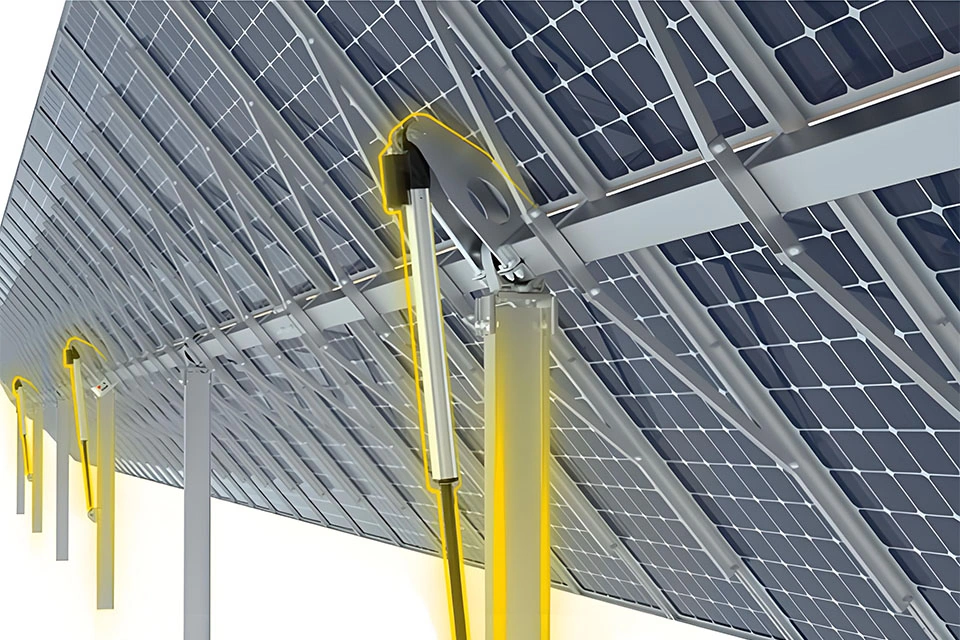
The actuator is the mechanical heart of any solar tracking system. It determines how accurately panels follow the sun, how well they hold position under wind load, and how often maintenance crews need to be dispatched to remote sites. When actuators underperform, the efficiency gains that justify tracker investment begin to erode — quietly, incrementally, and at scale.
This article examines the specific engineering challenges that cause solar trackers to underperform, and how ActuLift’s IP1200 heavy-duty linear actuator addresses each one — delivering a measurable improvement of up to 15% in overall system efficiency.
Table of Contents
The Challenge — Why Solar Trackers Underperform
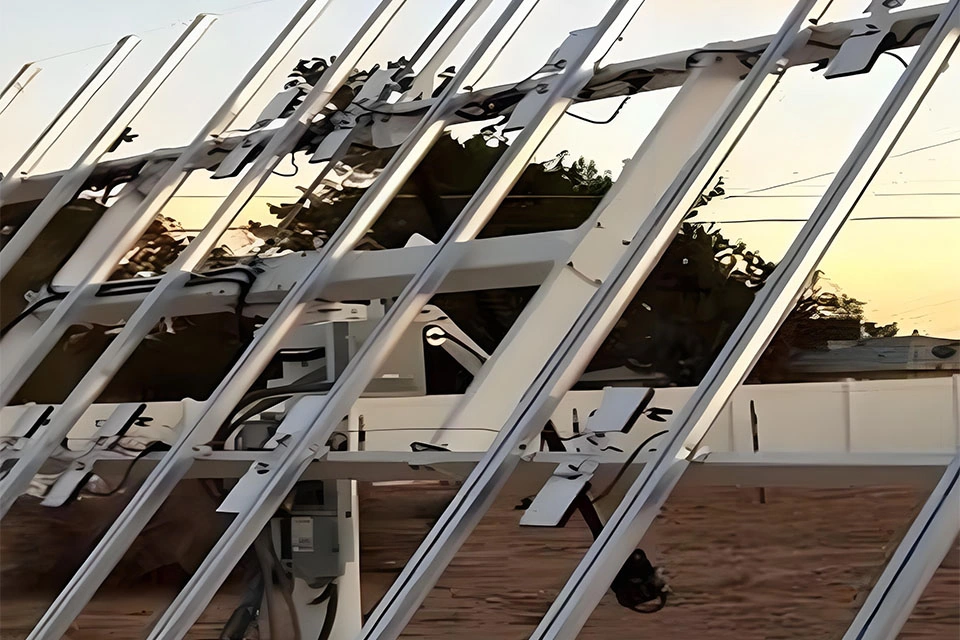
Solar tracking systems operate in some of the most demanding environments in industrial automation. Desert installations face extreme heat, abrasive dust, and sudden wind events. Northern deployments contend with sub-zero temperatures, ice loading, and freeze-thaw cycling. Coastal projects add salt spray and humidity to the equation. Against this backdrop, four core problems consistently limit tracker performance.
1. Wind-Induced Misalignment
Wind is the most immediate threat to tracking accuracy. A gust that pushes a panel array even 1° off its optimal sun-facing angle produces a measurable reduction in energy capture. At scale — across hundreds of tracker rows — these small deviations accumulate into significant yield losses over the course of a day.
Standard actuators without mechanical self-locking are particularly vulnerable. When wind force exceeds the actuator’s holding capacity, the panel drifts. The control system may not detect or correct this drift immediately, leaving panels misaligned for extended periods.
2. Harsh Environment Failures
Actuators in solar applications are exposed to conditions that accelerate component degradation: UV radiation, thermal cycling between -20°C and +60°C, dust infiltration into motor housings, and water ingress during rain events. Actuators with inadequate ingress protection ratings fail prematurely — seizing, corroding, or losing electrical continuity.
Each failure event triggers a service call. For remote solar farms, a single truck roll to replace a failed actuator can cost several hundred to several thousand dollars when labor, travel, and lost generation are factored in. Multiply that across a large installation and the maintenance cost profile becomes a significant drag on project economics.
3. Imprecise Positioning
Many standard actuators operate in open-loop mode — they move to a commanded position without feedback confirming actual panel angle. Over time, mechanical wear, thermal expansion, and load variation introduce cumulative positioning errors. A tracker that was accurate at commissioning may drift by several degrees over months of operation, with no automatic correction mechanism.
For dual-axis systems, where both azimuth and elevation must be controlled simultaneously, positioning errors compound. The result is a system that is nominally “tracking” but consistently missing the optimal angle.
4. High Maintenance Costs
The combination of environmental degradation and mechanical imprecision creates a maintenance burden that is disproportionately expensive in solar applications. Unlike factory automation where technicians are on-site daily, solar farms are often located in remote areas with minimal staffing. Frequent actuator replacements are not just a parts cost — they represent a systemic operational risk.
The Solution — IP1200 Actuator Capabilities
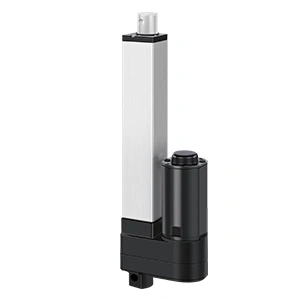
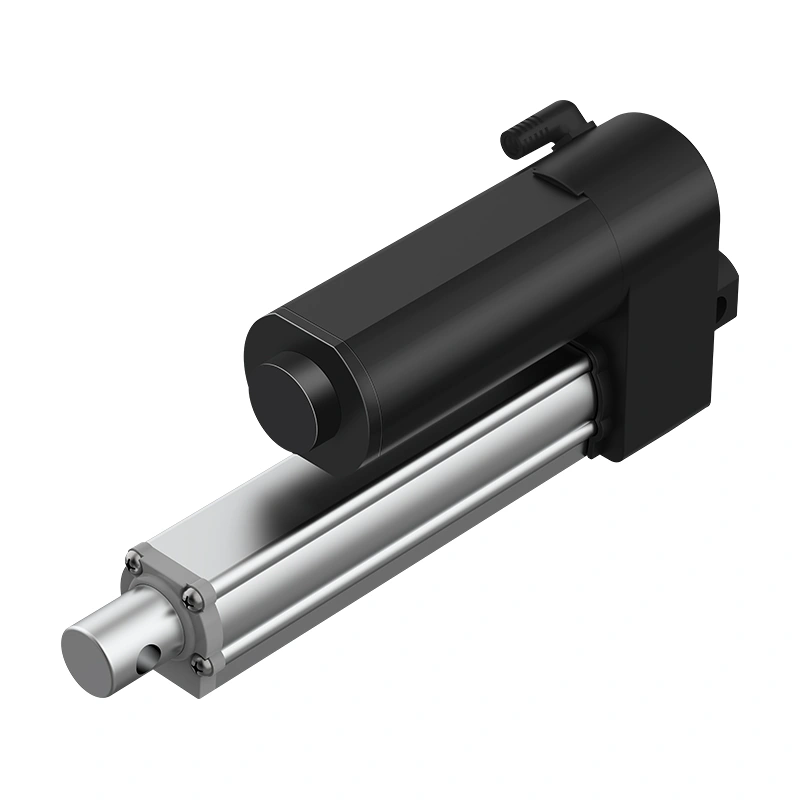
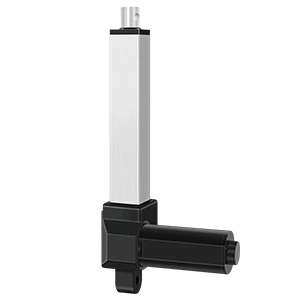
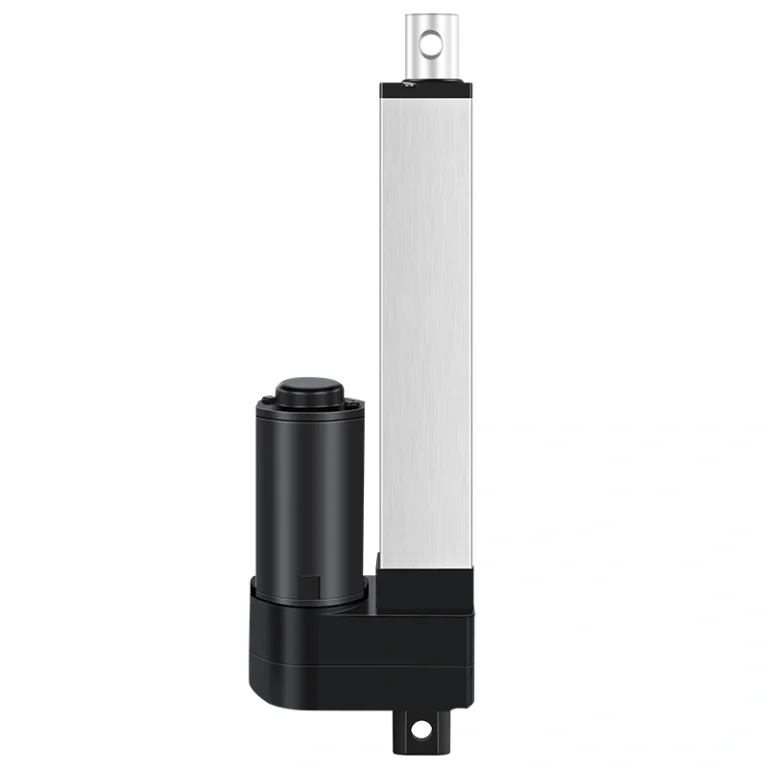
The ActuLift IP1200 is a heavy-duty linear actuator engineered specifically for demanding industrial applications, including solar tracking. Its design addresses each of the four challenge areas identified above through a combination of mechanical engineering, environmental protection, and optional sensor integration.
Wind Resistance
The IP1200 delivers a maximum push/pull force of 2,500N at 5mm/s — sufficient to maintain panel position against wind gusts exceeding 100 km/h [Source: ActuLift IP1200 Product Specifications]. This holding capacity is reinforced by a trapezoidal T-type lead screw, which provides mechanical self-locking. When the actuator is not actively moving, the lead screw geometry prevents back-driving — meaning wind force cannot push the panel out of position even if power is interrupted.
This is a critical distinction from ball-screw or hydraulic actuator designs, which may require continuous power to maintain position. The IP1200’s self-locking mechanism holds panel angle passively, with no energy consumption and no dependence on control system response time.
For system integrators evaluating actuator specifications, ActuLift provides detailed guidance on wind resistance solutions for solar tracking systems that covers load calculations and mounting configurations for high-wind environments.
Environmental Protection
The IP1200 carries an IP54 ingress protection rating — protected against dust ingress sufficient to prevent operational interference, and against water splashing from any direction [Source: ActuLift IP1200 Product Specifications]. This rating is appropriate for the majority of utility-scale solar farm environments, including desert, agricultural, and temperate climates.
The operating temperature range of -20°C to +60°C covers the full spectrum of solar deployment geographies, from northern European installations to Middle Eastern desert projects. The aluminum alloy housing provides corrosion resistance for long-term outdoor deployment without the weight penalty of steel alternatives.
The IP1200 is CE and RoHS certified, meeting European regulatory requirements for electrical equipment and hazardous substance restrictions. For project engineers evaluating ingress protection requirements across different site conditions, ActuLift’s comparison of IP54 dust and water protection rating versus IP43 and IP65 ratings provides a practical framework for specification decisions.
Precision Tracking
The IP1200’s most significant performance differentiator for solar tracking applications is its optional Hall sensor feedback system. When equipped with Hall sensors and 5-wire signal output, the actuator enables closed-loop position control with accuracy to 0.1° [Source: ActuLift IP1200 Product Specifications].
This level of precision eliminates the cumulative positioning errors that degrade open-loop tracker performance over time. The control system receives continuous position feedback, enabling real-time correction of any deviation from the commanded angle — whether caused by mechanical wear, thermal expansion, or transient wind loading.
The 5-wire feedback interface is compatible with standard tracker control systems and supports integration into both single-axis and dual-axis configurations. For engineers designing synchronized multi-actuator systems, ActuLift’s technical documentation on Hall sensor-enabled synchronized linear motion covers synchronization protocols and control architecture in detail.
Versatility and Low Maintenance
The IP1200 is available in stroke lengths from 30mm to 1,000mm, accommodating the full range of panel array geometries encountered in utility-scale solar projects [Source: ActuLift IP1200 Product Specifications]. Dual voltage options — 12VDC and 24VDC — provide compatibility with standard tracker control system power supplies.
Operating noise is rated below 48dB, relevant for installations near residential areas or wildlife-sensitive zones. The 10% duty cycle (2 minutes ON / 18 minutes OFF) aligns precisely with the intermittent movement pattern of solar trackers, which typically make small angular adjustments every 10–15 minutes throughout the day rather than operating continuously.
Mounting options include CG (fork-ear) and CP (trunnion) configurations, providing flexibility for different tracker frame designs without custom fabrication.
For a complete overview of the IP1200’s industrial application range, ActuLift’s heavy-duty industrial linear actuators product line documentation covers load ratings, mounting specifications, and application engineering support.
The Result — 15% Efficiency Improvement Breakdown
The 15% efficiency improvement achievable with IP1200-equipped solar trackers is not a single-source gain. It is the aggregate of three distinct performance improvements, each attributable to a specific technical capability of the actuator.
Precision Sun Tracking: ~8% Energy Gain
Hall sensor feedback maintains optimal panel angle throughout the solar day. Standard actuators operating in open-loop mode accumulate positioning errors of 5–10% in energy terms over a full day of operation, as small deviations from optimal angle compound across tracking cycles. Closed-loop control with 0.1° accuracy eliminates this loss category almost entirely.
For a tracker system operating 8–10 hours per day, the difference between a panel consistently at optimal angle versus one drifting by 2–3° represents a substantial and recoverable energy yield improvement.
Reduced Downtime: ~4% Energy Gain
IP54 protection combined with aluminum alloy housing significantly extends actuator service life in outdoor environments. Fewer failures mean fewer maintenance interventions — and more operational hours per year. This gain is particularly pronounced for remote installations where service visits are infrequent and each actuator failure may result in extended downtime before a technician can be dispatched.
A tracker row that is offline for even two days per year due to actuator failure loses approximately 0.5–1% of annual energy production. Across a large installation with multiple tracker rows, the aggregate downtime reduction from more reliable actuators translates directly to measurable yield improvement.
Wind Resilience: ~3% Energy Gain
Standard trackers without adequate actuator holding force are programmed to enter a protective stow position when wind speeds exceed a threshold — typically 50–60 km/h. During stow events, panels are rotated to a horizontal position to minimize wind load, and tracking is suspended until wind speeds drop.
The IP1200’s 2,500N static holding force and T-type lead screw self-locking allow trackers to continue operating through wind events that would force standard systems into stow. More tracking hours per year — particularly during the afternoon wind events common in many solar resource regions — translate directly to additional energy capture.
ROI Context
For a typical 1MW solar installation, a 15% efficiency improvement translates to approximately 150–200 MWh of additional annual energy production, depending on location and irradiance. At current wholesale electricity prices, this represents a meaningful improvement in project economics — and a corresponding reduction in levelized cost of energy (LCOE) over the project’s 20–25 year operational life.
IP1200 Technical Specifications
Parameter
Specification
Voltage
12VDC / 24VDC
Max Push/Pull Force
2,500N (at 5mm/s)
Stroke Range
30mm – 1,000mm
IP Rating
IP54
Noise Level
< 48dB
Operating Temperature
-20°C to +60°C
Lead Screw
Trapezoidal T-type
Housing
Aluminum alloy
Duty Cycle
10% (2 min ON / 18 min OFF)
Certifications
CE, RoHS
Optional Features
Hall sensor, magnetic switch, 5-wire feedback
Mounting Options
CG (fork-ear) / CP (trunnion)
Source: ActuLift IP1200 Product Specifications
Speed-Force Reference
Speed
Dynamic Force
Static Holding Force
5 mm/s
2,500N
2,500N
10 mm/s
1,200N
1,200N
20 mm/s
600N
600N
40 mm/s
300N
200N
Source: ActuLift IP1200 Product Specifications
Frequently Asked Questions
What IP rating does the IP1200 have, and is it sufficient for outdoor solar installations?
The IP1200 carries an IP54 rating — protected against dust ingress sufficient to prevent operational interference, and against water splashing from any direction [Source: ActuLift IP1200 Product Specifications]. This is appropriate for the majority of utility-scale solar farm environments, including desert, agricultural, and temperate climates. For extreme coastal environments with salt spray exposure, or applications requiring submersion protection, additional enclosure measures or a higher-rated actuator variant may be recommended.
Can the IP1200 support dual-axis solar tracking?
Yes. With optional Hall sensor feedback and 5-wire signal output, the IP1200 integrates into dual-axis tracking systems with 0.1° positioning accuracy [Source: ActuLift IP1200 Product Specifications]. The 5-wire interface supports closed-loop control integration with standard tracker control systems for both azimuth and elevation axes.
What is the maximum wind speed the IP1200 can withstand?
With 2,500N static holding force and T-type lead screw self-locking, the IP1200 maintains panel position in gusts exceeding 100 km/h [Source: ActuLift IP1200 Product Specifications]. The mechanical self-locking mechanism holds position passively without requiring continuous power or active control system intervention.
How does the 10% duty cycle work for solar tracking applications?
Solar trackers make small, intermittent angular adjustments throughout the day — typically a few seconds of actuator movement every 10–15 minutes as the sun’s position changes. The IP1200’s 10% duty cycle (2 minutes ON / 18 minutes OFF) aligns precisely with this usage pattern, ensuring the actuator operates well within its thermal limits throughout a full tracking day [Source: ActuLift IP1200 Product Specifications].
Does ActuLift offer custom stroke lengths for different panel configurations?
Yes. The IP1200 supports strokes from 30mm to 1,000mm, and ActuLift provides custom OEM/ODM actuator solutions for projects with specific dimensional, force, or interface requirements. Custom configurations are available for large-volume OEM and EPC contractor engagements.
Specify the Right Actuator for Your Solar Tracker Project
Actuator selection is a critical engineering decision in solar tracker design. The wrong specification — inadequate holding force, insufficient ingress protection, or open-loop positioning — can undermine the energy yield improvements that justify tracker investment in the first place.
The ActuLift IP1200 is engineered to meet the mechanical, environmental, and precision requirements of utility-scale solar tracking applications. Its combination of 2,500N holding force, IP54 protection, -20°C to +60°C operating range, and optional Hall sensor feedback provides a technically sound foundation for both single-axis and dual-axis tracker systems.
To discuss actuator specifications for a specific solar tracker project — including custom stroke lengths, voltage requirements, or OEM integration — contact ActuLift’s engineering team for a technical consultation.
All product specifications sourced from ActuLift IP1200 Product Catalog. Efficiency improvement figures represent achievable performance gains based on documented technical capabilities; actual results will vary depending on installation conditions, control system configuration, and baseline actuator performance
Get Expert Insights on Industrial Motion Control
Selecting the right electric linear actuator or lifting column is critical for your project's performance. As a professional Motion Control & Automation Manufacturer, our engineers help you customize load capacity, stroke length, and IP ratings based on your specific application. Share your technical requirements for a tailored solution.
ActuLift supports end-to-end customization, from structural design and stroke parameters to branding and casing finishes, helping you build a powerful brand identity.
Rapid Response & Prototyping
We understand the importance of speed in B2B procurement, utilizing optimized production workflows to ensure efficient responses from sample development to bulk delivery.
Stable Quality & Traceability
With ISO9001 quality assurance, every product—from material entry to final factory testing—is recorded in our electronic logs, ensuring high consistency in delivered goods.